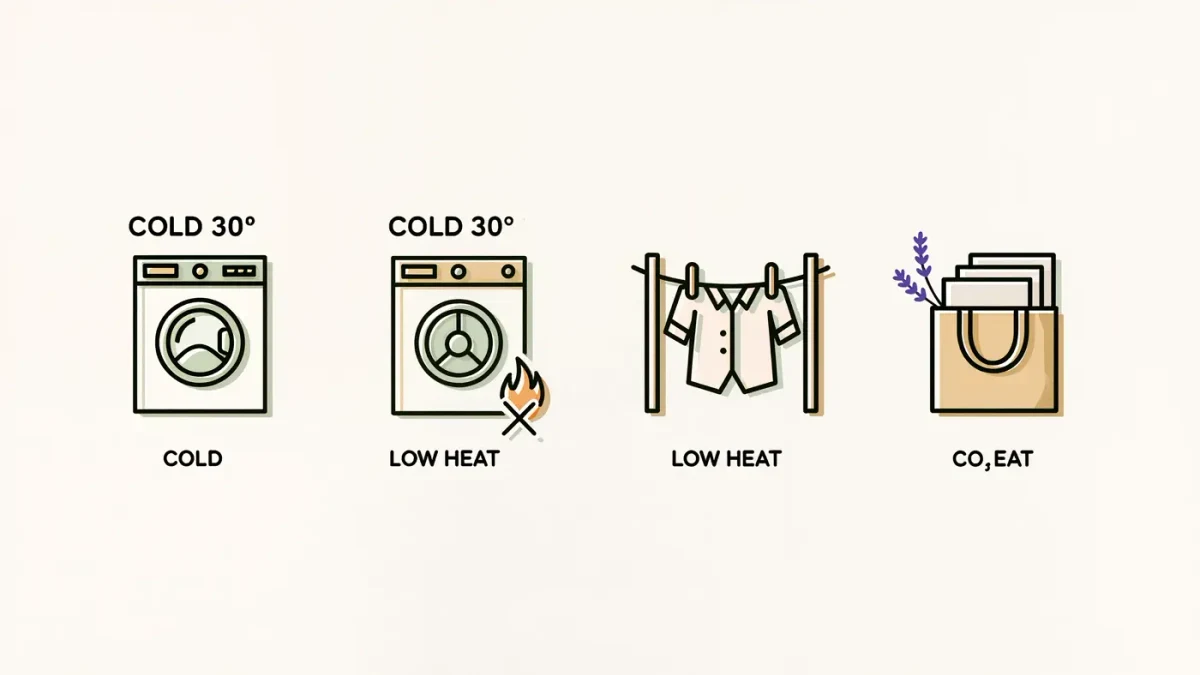
Linen asks for very little: wash it cool on a gentle cycle with mild detergent, tumble low or line-dry, and store it folded in a breathable space rather than hung and squeezed into plastic. Do that and linen rewards you for decades — the flax fiber actually gets softer and more lustrous with each wash, which is why a worn-in linen shirt becomes the best shirt you own.
How should you wash linen?
Cold or lukewarm water (up to about 30°C / 86°F), gentle cycle, mild liquid detergent, and — the step people skip — no overload. Linen creases most when cramped against other fabric while soaked, so a half-full drum washes it better than a packed one. Wash lights and darks separately for the first few cycles since linen dye can release some color early on. Skip bleach entirely: chlorine weakens flax fiber and yellows it over time, and even oxygen bleach should be an occasional guest, not a resident.
Stains come out of linen readily if you move fast: cold water from the back of the fabric, a drop of gentle detergent worked in with your fingers, and patience. Grease takes a sprinkle of baking soda or cornstarch left for an hour first. What you should never do is scrub hard or use hot water on a stain — heat sets protein stains like sweat and blood, and linen is too honest a fabric to hide the damage afterward.
To iron or not to iron?
Mostly, not to. The wrinkles are the point — pressed-flat linen reads like a hotel brochure, while naturally creased linen reads like a person on a good holiday. Lean in: wear the crumple. If a piece genuinely needs taming (a shirt collar, a tablecloth for hosting), iron it while still damp on medium-hot with steam, pressing on the wrong side where possible; a damp cloth between iron and fabric protects mid-tones from shine. Clothes that hate irons respond to steam — a hand steamer held an inch away relaxes linen in two minutes flat.
The half-measure worth knowing: pull linen from the dryer while slightly damp, smooth it with your hands, and let it finish drying flat or on a hanger. That alone removes the harshest creases and leaves the soft, lived-in ones. Line-drying outdoors gives the best smell and the gentlest treatment, though bright sun over years will gradually fade darks — dry colored linen in shade.
How do you dry linen properly?
Low heat, short cycle, slightly damp exit — that's the whole dryer philosophy. High heat is the one genuinely destructive thing you can do to linen in daily life: it shrinks the fiber (expect real shrinkage on the first hot wash-dry of an unwashed garment, sometimes 4–5 percent) and brittles it over months. Line-drying keeps dimensions stable forever, which matters most for bedding and anything tailored. If a garment is pre-washed or labeled "stonewashed," it has already done most of its shrinking at the factory and will behave.
Timing tip for the line: bring linen in while it's barely, evenly damp rather than bone-dry in the sun — over-dried flax feels papery and creases harder. And resist wringing; twist-wringing linen sets deep, irregular creases into the weave. Press water out with your hands or roll the garment in a clean towel for thirty seconds.
What's the best way to store linen?
Cool, dry, dark, and able to breathe. Fold clothing with as few sharp creases as you can manage (smoothing by hand as you go), and store in a drawer or on a shelf — not on wire hangers, which put permanent points into shoulders. For long-term storage, cotton or canvas garment bags and pillowcases beat plastic every time: plastic traps moisture and yellows linen, while fabric lets the fiber rest. A sachet of dried lavender in the drawer handles the moth question without mothball fumes; cedar blocks work too, refreshed with cedar oil once a season.
Bedding earns its own note: rotate two or more linen sheet sets rather than running one into the ground, refit the fitted sheet with hospital corners folded flat (folding a fitted sheet "properly" is optional; living a full life is fine), and give stored sets an hour of air after washing before they go in the closet. Stored dry, linen bedding lasts ten-plus years and keeps improving — the rare purchase that's better in year eight than year one.
One last permission slip: linen is meant to be used hard. Aprons, napkins, throw covers — flax is stronger wet than dry, among the most durable natural fibers there is, and it takes years of picnics and pasta sauce without complaint. The pieces people baby in the back of a closet never develop the softness that makes linen worth owning. Wash it often, dry it gently, and let it wrinkle — that's the entire care manual, and it fits on a refrigerator magnet.
FAQ
Does linen shrink in the wash?
Yes — on its first hot wash and dry, expect up to about 4–5 percent shrinkage. Wash cool and dry low from the start and shrinkage is negligible. Pre-washed or stonewashed linen has already shrunk at the factory and stays true to size with normal care.
Why is my linen scratchy, and will it soften?
New linen is starched and stiff from finishing; it softens dramatically over roughly ten washes as the flax fibers relax and break in. Skip fabric softener — it coats the fiber and actually slows the natural softening. Vinegar (a half-cup in the rinse) speeds the process without residue.
Can linen go in the dryer?
Yes, on low heat, pulled out while slightly damp. High heat is the enemy — it shrinks and brittles flax over time. For bedding and tailored pieces, line-drying keeps the fit and dimensions stable for the life of the garment.
For more context, read What Your Clothing Care Label Is Actually Telling You.
For more context, read how to set a table.
For more context, read leather shoe care.